
Most RNA isolation techniques currently in use have been developed for the processing of large quantities of material. These typically involve multiple phenol extractions (Reinert et al. 1981 Mol. Cell Biol. 1:829-836) or guanadinium isothio-cyanate/cesium chloride gradients (Chirgwin et al. 1979 Biochem 18:5294-5299) and can be both expensive and time consuming. Often, however, needs arise where quantitatively smaller amounts of RNA are needed from many different samples, for example, during time series analyses or when screening transfor-mants for expression of a transformed gene. Under such circumstances, existing tech-niques are overly time consuming and yield more RNA than is necessary. The availability of a rapid RNA mini-prep is thus desirable. Such a system has been developed for isola-ting plant RNA (Nagy et al. 1988 Plant Molecular Biology Manual, B4; ed. Gelvin and Schilperoort, Klewer Academic Publishing, pp. 1-29), and we have adapted this procedure for use with Neurospora and, potentially, other filamentous fungi. Below, we describe the use of this procedure with 50 ml mycelial cultures, although we have used in with equal success with 5 ml cultures without scaling down the amounts of any reagents.
The method involves the use of a triphenylmethane dye, aurintricarboxylic (ATA), to protect the RNA. ATA binds irreversibly to RNA and is a potent inhibitor of most nucleic acid binding enzymes (Hallick et al. 1977 Nucl. Acids Res. 4:3055-3064). Thus, RNA made with procedure cannot be used for in vitro transcription or translation or reverse transcription but works fine for RNA/DNA or RNA/RNA hybridizations.
To minimize RNase contamination, all glassware is baked at 182°C for at minimum of four hours. Work with gloved hands. The procedure is as follows:
1. Conidia from slants (grown in 16 x 150 mm test tubes containing 8 ml of solid medium) are resuspended in 50 ml of Horowitz complete medium (Horowitz 1947 J. Biol. Chem. 171:255-262) and the cultures grown overnight with shaking at 30°C. A 50 ml culture typically yields enough RNA for 200 gel lanes (see below), and, as noted, smaller culture volumes may be used.
2. Flat mycelial pads are easier to grind than mycelial balls. Therefore, filter cultures using a Buchner funnel onto Whatman #44 filter paper. Wrap flat mycelial pads in aluminum foil and freeze in dry ice. Do not freeze in EtOH/dry ice bath because alcohol might seep through foil. Pads can be stored at -70°C for at least three weeks.
3. Wash a mortar and pestle thoroughly with warm water and Alconox (Fisher Scientific); cool by filling with liquid N2. Remove frozen, flat mycelia from foil and add it to the liquid N2 in mortar. Add ~0.5 g of baked sand and grind mycelial pad to a fine powder. Add more N2 as needed. Mortar and pestle should be washed after every sample.
4. Working quickly before powder can thaw, pour or spoon ground mycelia into 15 ml round bottom Sarstedt tube (Sarstedt tubes #60.540, Princeton, NJ) containing 8 ml of E buffer at room temperature. [E buffer: 50 mM Tris-Cl pH 8.0, 300 mM NaCl, 5 mM EDTA, pH 8.0, 2 SDS; autoclave and add 1 mM ATA and 14 mM ?-mercaptoethanol. ATA=aurintricarboxylic acid, ammonium salt (Sigma #A0885, St. Louis, MO)]
5. Thaw the powder in E buffer in 42°C water bath, occasionally shaking, to get SDS into solution. This should take about 5 minutes.
6. Add 1.1 ml of 3M KCl, invert to mix, keep on ice for 10 min. Solution should form semi-solid, flocculent mass as K-SDS precipitate forms.
7. Spin at 3000g, 4°C in a fixed angle rotor. Make sure caps are screwed on tightly to prevent tubes from collapsing.
8. Pass supernatant through 50 micron Miracloth (Calbiochem #475855, La Jolla, CA) in a funnel into fresh Sarstedt tube.
9. Measure volume of average-sized sample. Add 0.5 vol. 8 M LiCl, mix and stand at 4°C overnight.
10. Spin at 12000g, 4°C, for 15 min in a fixed angle rotor. Thoroughly resuspend pellet in 4 ml sterile gd (glass distilled) H2O with pasteur pipette.
11. Extract twice with phenol/chloroform/isoamyl alcohol (25:24:1), spinning 12000g 10 min at 4°C in a fixed angle rotor. Save aqueous (upper) phase; add gd H2O if volume is less than 2 ml.
12. Add 0.1 vol 3M NaOAc pH 6.0, mix and add 2.5 vol EtOH, mix. Place at -20°C overnight or -70°C for 15 min.
13. Spin 12000g, 10 min, 4°C. Wash pellet with 70 EtOH and drain. Pellet should be a light pink or white.
14. Resuspend in 0.4 ml sterile gd H2O in a microfuge tube. Precipitate with NaOAc and EtOH as in step 12.
15. Spin 10-20 min in microfuge. Wash twice with 70 EtOH and dry pellet. Resuspend in 200 μl of sterile RNase-free gd H2O. Store at -70°C for up to three months. Spectophotometric quantification may be done at this point.
16. Load 1 μl onto a formaldehyde gel. Electrophorese overnight at 20 volts. Blot onto nitrocellulose. Probe with DNA fragment of choice. Expose to film.
Yields are typically on the order of 1-2 mg total RNA from an overnight 50 ml culture arising from an average slant. The number of samples able to be processed using this procedure is limited by the number of spaces in a centrifuge rotor. We have done as many as 24 samples in one day, and doing several times this many would be possible. We have observed on ethidium bromide stained gels that the fluorescence from the RNA deriving from this miniprep is brighter than that seen when the corresponding amount of standard-prep RNA is used. This may be due to enhanced fluorescence of RNA in the presence of ATA. However, autoradiography of the blots does not show any RNA degradation products (Figure 1). This procedure would probably work fine with other methods of tissue disruption. ATA inhibits many nucleic acid binding proteins, possibly by competing for binding sites (Blumenthal and Landers 1973. BBRC 55:680-688). Therefore, the most critical factor is getting the RNA in contact with ATA before nucleases can bind to the nucleic acid and degrade it. Supported by federal grants to J.J.L. and J.C.D.
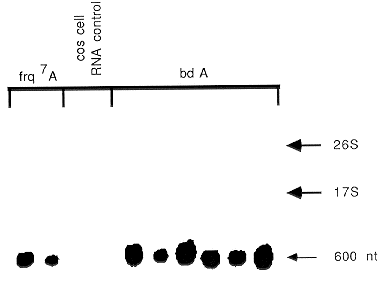
Fig. 1. ATA mini-prep RNA probed with ccg-1 DNA fragment. Total RNA from a series of transformants into bd A and frq7 A was examined for the presence of the ccg-1 gene transcript (Loros et al. 1989 Science 243:385-388). Each lane contains 10 μg of RNA (1/200 of the preparation). While the fluorescence staining of the RNA extended from the 26S to below the 17S RNA bands (not shown), the hybridization revealed the presence of only a single undegraded transcript in each lane containing transformant RNA and no hybridization to the monkey cos cell RNA control.
現代生命離不開三樣東西:DNA、蛋白質和RNA。但問題是,它們不可能同時出現。蛋白質就像建筑工人和建筑材料,沒有蛋白質,DNA無法復制;DNA就像建筑藍圖,沒有DNA,蛋白質無法構建。為了解開這個“先......
據27日《自然》雜志報道,英國倫敦大學學院(UCL)化學家通過模擬早期地球的條件,首次實現了RNA與氨基酸的化學連接。這一難題自20世紀70年代以來一直困擾著科學家,如今,這一突破性成果為解答生命起源......
美國芝加哥大學團隊開發了一種更為靈敏的液體活檢技術,該方法利用RNA而不是傳統的DNA來檢測癌癥。這一創新方法在使用患者血液樣本進行測試時,識別出早期結直腸癌的準確率達到95%,顯著優于現有的非侵入性......
由新加坡科技研究局基因組研究所領導的科學家團隊,發布了迄今全球最大、最全面的長讀長RNA測序數據集之一——新加坡納米孔表達數據集(SG-NEx)。這一成果有望解決疾病研究中長期存在的技術瓶頸,使研究人......
4月15日,中國工程院院士、中國科學院亞熱帶農業生態研究所首席研究員印遇龍領銜的單胃動物營養研究團隊在科技合作和成果轉化上取得新進展。其團隊博士生王芳以“RNA技術研發與產業化應用”為主的項目,歷經初......
近日,中山大學生命科學學院教授張銳團隊首次提出名為MIRROR的全新內源性ADAR招募gRNA設計理念,顯著提高了RNA編輯效率,這一突破為RNA編輯技術走向臨床應用注入了強勁動力,同時也為相關疾病的......
中國科學院分子細胞科學卓越創新中心陳玲玲研究組揭示了雙鏈RNA依賴的蛋白激酶R(PKR)在阿爾茨海默病(AD)發生與進展過程中異常激活的分子病理特征,開發了基于具有分子內短雙鏈結構環形RNA(ds-c......
在癌癥治療領域,化療藥物耐藥性問題一直是阻礙治療效果提升的關鍵瓶頸。癌細胞擁有多種復雜的機制,能夠巧妙地逃避化療藥物的“攻擊”,其中,高活性的抗氧化系統可以有效減輕藥物誘導的活性氧(ROS)損傷,成為......
比利時布魯塞爾自由大學主導的一項研究揭示,DNA和RNA的表觀遺傳學協同調控比過去想象的更加緊密。這項發表在最新一期《細胞》雜志上的研究,結合了DNA和RNA研究結果,指出這兩種調控方式共同作用,形成......
近日,廣州醫科大學-中國科學院廣州生物醫藥與健康研究院聯合生命科學學院特聘教授、廣州實驗室研究員苗智超團隊與合作者,對來自全球18個團隊的預測進行了大規模評估,涉及23個RNA結構,包括RNA元件、適......